
Complete Guide to GST 2026: The Ultimate Registration & Rates Breakdown
Welcome to the ultimate Complete Guide to GST 2026. The Goods and Services Tax framework has evolved significantly, making it essential to understand the latest compliance norms, registration limits, and return filing protocols.
📋 Table of Contents
1. GST Basics
The GST framework is fundamentally designed as a destination-based consumption tax. This means the revenue accrues to the state where the goods or services are finally consumed, rather than the state where they are produced. This was a radical shift from the origin-based tax system that India followed prior to 2017. The transition required a massive overhaul of the technological infrastructure, culminating in the creation of the Goods and Services Tax Network (GSTN). The GSTN serves as the digital backbone, handling millions of returns and invoices every month. Understanding this backbone is essential because the entire compliance mechanism is entirely electronic. Under the Complete Guide to GST 2026, there are no manual filings accepted under this regime. The Complete Guide to GST 2026 requires every taxpayer to reconcile their purchase data with the sales data uploaded by their suppliers. This reconciliation is the heart of Input Tax Credit (ITC), ensuring that tax is only paid on the value addition at each stage. This eliminates the cascading effect of taxes, a major flaw in the pre-GST era. The Complete Guide to GST 2026 covers five key components: the Central GST (CGST), the State GST (SGST), the Integrated GST (IGST) applicable on inter-state supplies and imports, the Union Territory GST (UTGST), and the GST Compensation Cess. Each has its own set of rules, rates, and compliance requirements. Under the framework, three taxes flow simultaneously on every domestic B2B transaction: CGST goes to the Centre, SGST goes to the State, and IGST replaces both for inter-state trades. The recipient of an IGST-charged invoice can claim IGST credit and use it against both CGST and SGST liabilities. This seamless cross-utilization is one of the landmark improvements of the GST era as documented in the Complete Guide to GST 2026.
2. Registration Requirements
Registration is the first and arguably most critical step in entering the formal economy under the Complete Guide to GST 2026. The threshold limits for mandatory registration vary significantly depending on the nature of the business and the state of operation. For businesses exclusively engaged in the supply of goods, the threshold is generally set at Rs. 40 Lakhs for normal category states. For special category states in the North-Eastern region, this limit is reduced to Rs. 20 Lakhs or even Rs. 10 Lakhs in certain cases to protect the revenue base of these smaller economies. For service providers, the standard threshold limit remains at Rs. 20 Lakhs across most states under the Complete Guide to GST 2026. These limits are based on aggregate turnover, which includes all taxable supplies, exempt supplies, exports, and inter-state supplies of persons having the same PAN. The Complete Guide to GST 2026 explicitly states that voluntary registration is permitted, and many businesses opt for this to pass on Input Tax Credit to their B2B customers. A business without a GSTIN cannot issue a tax invoice or collect tax, which disqualifies them from participating in lucrative corporate supply chains or government tenders. Mandatory registration is also required irrespective of turnover for: persons making inter-state taxable supplies, casual taxable persons, non-resident taxable persons, and those required to pay tax under the reverse charge mechanism. The registration application is filed online in Form GST REG-01 and authorities are required to process it within 7 working days. Non-compliance with registration norms can lead to penalties up to Rs. 10,000 or the tax amount evaded, whichever is higher, as per the Complete Guide to GST 2026.
💡 CA Pranay’s Pro-Tip
In our practice at Taxology, we frequently see business owners delay their registration. The Complete Guide to GST 2026 emphasizes that voluntary registration is often better if you deal with B2B clients who demand ITC. A GSTIN signals credibility and seriousness to corporate buyers.
💰 Rupee Case Study: The Cost of Late Registration
Scenario: Mr. Sharma started a cloud-kitchen in Mumbai. His turnover crossed ₹20 Lakhs in August 2026. He ignored registration until December 2026.
Outcome: The department forced him to pay 18% GST out of pocket (₹2,70,000) plus 18% interest. Delaying cost him nearly ₹3 Lakhs total. Moral: Follow the Complete Guide to GST 2026 and register on time.
3. Returns Filing
Filing returns accurately and on time is the cornerstone of remaining compliant under the Complete Guide to GST 2026. The return filing ecosystem consists of several forms, each serving a specific purpose. GSTR-1 is the foundational return where a taxpayer declares all outward supplies during the tax period. This return is essential because the data entered here flows directly into the GSTR-2A and GSTR-2B of the recipient, enabling them to claim Input Tax Credit. The due date for GSTR-1 is typically the 11th of the succeeding month. Following this, GSTR-3B is the summary return where the taxpayer declares the total tax liability, claims the eligible ITC, and pays the net tax due in cash. The Complete Guide to GST 2026 highlights that the due date for GSTR-3B is generally the 20th of the succeeding month. Discrepancies between GSTR-1 and GSTR-3B are the most common triggers for automated notices from the tax department. Beyond these monthly returns, taxpayers are also required to file an annual return in Form GSTR-9, which consolidates the data for the entire financial year. For businesses with a turnover exceeding Rs. 5 Crores, a reconciliation statement in Form GSTR-9C, certified by a Chartered Accountant or Cost Accountant, is also mandatory. Failure to file GSTR-9 on time attracts a late fee of Rs. 200 per day, subject to a maximum of 0.25% of turnover in the state. The Complete Guide to GST 2026 strongly recommends maintaining a monthly compliance calendar with reminders for all due dates.
| Return Form | Purpose | Due Date |
|---|---|---|
| GSTR-1 | Outward Supplies Declaration | 11th of next month |
| GSTR-3B | Summary Return & Tax Payment | 20th of next month |
| GSTR-9 | Annual Return | 31st December |
| GSTR-9C | Reconciliation Statement | 31st December |
4. Input Tax Credit
Input Tax Credit (ITC) is often described as the soul of the GST system and is central to the Complete Guide to GST 2026. It is the mechanism that prevents the cascading effect of taxes by allowing a business to reduce its tax liability on outward supplies by the amount of tax already paid on inward supplies. However, claiming ITC is not an absolute right; it is subject to strict conditions laid out in Section 16 of the CGST Act. Firstly, the buyer must be in possession of a valid tax invoice or debit note issued by a registered supplier. Secondly, the buyer must have actually received the goods or services. The Complete Guide to GST 2026 places tremendous emphasis on the third condition: the tax charged must have been actually paid to the government by the supplier. This shifted the burden of ensuring the supplier’s compliance onto the buyer, making vendor management a critical aspect of business operations. Finally, the buyer must have furnished the return under Section 39. Recent amendments have further tightened these rules by linking ITC availability strictly to GSTR-2B. Even if a buyer possesses a valid invoice and has paid the supplier, they cannot claim ITC unless it reflects in the buyer’s auto-generated GSTR-2B statement. This hard linkage has forced businesses to rigorously follow up with their vendors on a monthly basis. The Complete Guide to GST 2026 recommends that every business implement a robust vendor compliance monitoring system to avoid surprise ITC reversals at the time of assessment.
💰 Rupee Case Study: ITC Mismatch Penalty
Scenario: TechSolutions Pvt Ltd claimed ₹1,80,000 in ITC in October 2026. Their vendor had not filed GSTR-1, so the amount did not appear in the buyer’s GSTR-2B.
Outcome: They were forced to reverse the ₹1,80,000 ITC and pay 24% per annum interest. Total loss: ₹2,15,000+. Follow the Complete Guide to GST 2026 and implement a vendor compliance monitoring system.
- Step 1: Verify every purchase invoice has a valid GSTIN and correct tax amount.
- Step 2: Match invoices against your auto-generated GSTR-2B by the 14th of every month.
- Step 3: Follow up with vendors whose invoices are missing from 2B before filing 3B.
- Step 4: Claim only the ITC visible in GSTR-2B to remain safe under the Complete Guide to GST 2026.
5. Reverse Charge Mechanism
The Reverse Charge Mechanism (RCM) represents a fundamental deviation from the standard tax collection process and is a key chapter in the Complete Guide to GST 2026. Under RCM, the liability to pay the tax falls directly on the recipient of the supply rather than the supplier. This mechanism is primarily used to bring unorganized sectors into the tax net. A classic example is the services provided by a Goods Transport Agency (GTA). If a registered business avails GTA services, it is typically required to pay tax under RCM at 5% without ITC or 12% with ITC. Legal services provided by an individual advocate or a firm of advocates also fall under the RCM net, making the corporate client liable for the tax. The Complete Guide to GST 2026 clarifies that when a taxpayer pays tax under RCM, they must do so entirely through the Electronic Cash Ledger. ITC cannot be utilized to offset an RCM liability. However, once the RCM tax is paid in cash, the taxpayer can immediately claim it as Input Tax Credit in the same month GSTR-3B, provided the underlying expense is eligible for ITC. Businesses must maintain a self-invoicing mechanism when receiving supplies from unregistered persons under RCM, ensuring a complete audit trail as mandated by the Complete Guide to GST 2026.
💡 CA Pranay’s Pro-Tip
In our practice at Taxology, we see many businesses forget to pay RCM on GTA or legal services and then face massive interest demands during audits. Always set a monthly reminder for RCM payments as per the Complete Guide to GST 2026. The good news is you get the same ITC back immediately.
6. E-way Bill
The E-way Bill system was introduced to track the physical movement of goods across India and is thoroughly covered in the Complete Guide to GST 2026. An E-way Bill is an electronic document generated on the national portal evidencing the movement of goods. It is mandatory for inter-state movement of goods where the consignment value exceeds Rs. 50,000. For intra-state movement, the threshold limits vary by state. The generation of an E-way Bill requires detailed information including the GSTIN of supplier and recipient, HSN codes, invoice details, and the vehicle number. The Complete Guide to GST 2026 emphasizes the critical nature of the validity period of an E-way Bill, which is calculated based on the distance to be traveled, typically one day for every 200 kilometers. If the goods are intercepted by tax officials and the E-way Bill is found to be expired, missing, or containing errors such as an incorrect vehicle number, the authorities have the power to detain the vehicle and seize the goods. The penalties for such infractions are extremely harsh, often amounting to 200% of the tax payable on the goods. Therefore, businesses must implement robust logistics protocols as outlined in the Complete Guide to GST 2026 to ensure E-way Bills are generated accurately and updated promptly if transshipment occurs.
💰 Rupee Case Study: E-way Bill Seizure
Scenario: Mr. Verma transported goods worth ₹80,000 from Delhi to Jaipur without an E-way Bill, thinking it was a short trip.
Outcome: The goods were seized at a checkpost. He paid a penalty of ₹32,000 (200% of the applicable tax) plus ₹5,000 in detention charges. Total loss: ₹37,000+. The Complete Guide to GST 2026 mandates an E-way Bill for all inter-state consignments above ₹50,000.
7. Penalties
The penal provisions under the GST law are designed to ensure strict compliance and are a key warning in the Complete Guide to GST 2026. Late fees are the most common financial penalty. Failing to file GSTR-1 or GSTR-3B by the due date attracts a daily late fee of Rs. 50 for taxable returns and Rs. 20 for nil returns, subject to statutory maximum caps based on turnover. Interest on delayed payment of tax is levied at 18% per annum. Importantly, if a taxpayer claims and utilizes excess Input Tax Credit, the interest rate escalates to 24% per annum. The Complete Guide to GST 2026 details the severe penalties under Section 122 of the CGST Act for specific offenses. Supplying goods or services without an invoice, issuing an invoice without actual supply, or failing to deposit collected tax within three months attracts a penalty of Rs. 10,000 or an amount equivalent to the tax evaded, whichever is higher. For extreme cases involving massive fraud or fake ITC networks, the law provides for prosecution which can result in imprisonment for up to five years. The Complete Guide to GST 2026 strongly advises businesses to engage a professional CA firm to ensure they never face these situations.
Want to calculate your exact late fees? Use our free GST Late Fees Calculator to avoid surprises. Also check our post on Capital Gains Tax on Mutual Funds 2026.
8. Notices
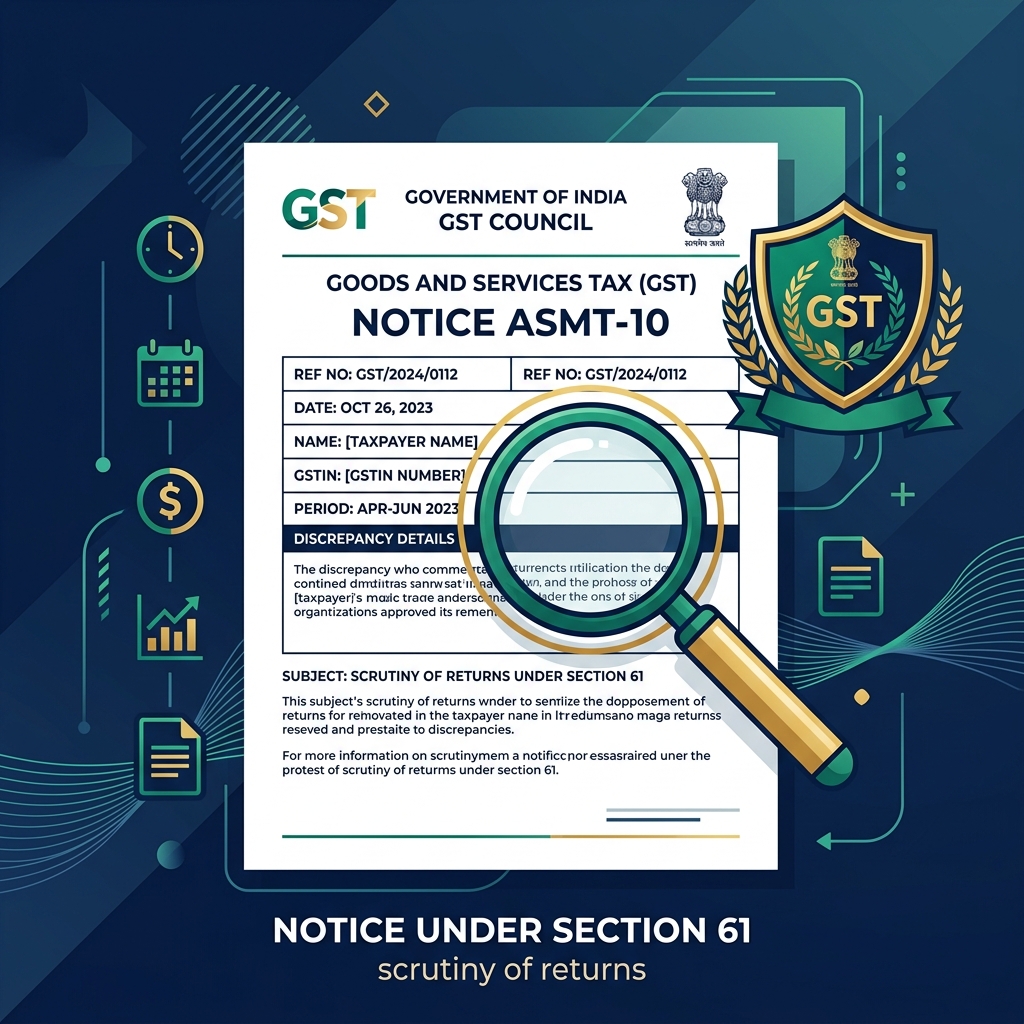
Receiving a notice from the GST department is a high-stress event for any business, and understanding how to handle one is a critical part of the Complete Guide to GST 2026. The most common notice is the ASMT-10, which is issued when the automated system detects discrepancies between returns. For example, if the tax liability declared in GSTR-1 is significantly higher than the tax paid in GSTR-3B, an ASMT-10 will be generated. The taxpayer is given an opportunity to explain the discrepancy or pay the differential tax along with interest. Ignoring an ASMT-10 is a fatal error. The Complete Guide to GST 2026 warns that failure to respond satisfactorily leads to the issuance of a show-cause notice under Section 73 for non-fraud cases or Section 74 for fraud cases, initiating formal adjudication proceedings. Other common notices involve the suspension of GST registration, typically triggered by non-filing of returns for six consecutive months. When registration is suspended, the taxpayer cannot issue tax invoices or operate their business legally until the suspension is revoked. The Complete Guide to GST 2026 recommends that every notice reply be vetted by a qualified Chartered Accountant before submission to ensure the right legal position is taken.
💡 CA Pranay’s Pro-Tip
In our practice at Taxology, we have seen businesses completely ignore ASMT-10 notices thinking they are automated and irrelevant. Never do this. Every notice has a strict reply deadline. Missing it is treated as an admission of guilt. The Complete Guide to GST 2026 requires you to respond within 30 days of the notice date.
10. Practical GST Compliance Calendar 2026
One of the most valuable tools in the Complete Guide to GST 2026 is a well-maintained compliance calendar. Every GST-registered business must maintain a strict schedule to ensure no deadline is missed. The 11th of every month is the date by which GSTR-1 must be filed, declaring all outward supplies. By the 20th, GSTR-3B must be filed and net tax must be paid. These two dates form the backbone of monthly GST compliance under the Complete Guide to GST 2026. However, there are additional quarterly and annual deadlines that are often overlooked. The GSTR-9 annual return must be filed by December 31st for the preceding financial year. For composition scheme taxpayers, the CMP-08 quarterly challan is due by the 18th of the month following the end of the quarter, and GSTR-4 is due annually by April 30th. The Complete Guide to GST 2026 recommends that businesses set up automated reminders for all these dates in their accounting software. Missing even a single deadline triggers late fees that compound daily. A practical tip from our Taxology CA team: treat the 5th of every month as your internal “GST preparation day.” On this date, lock your sales register, tally your purchase invoices against GSTR-2B, and have all data ready for your CA to file by the 11th. This buffer of six days before the GSTR-1 deadline eliminates last-minute scrambles and the errors that arise from rushed data entry. The Complete Guide to GST 2026 emphasizes that accuracy in GSTR-1 is non-negotiable because any errors will cascade into your buyer’s ITC calculations and could damage your business relationships and reputation.
Key Monthly GST Compliance Dates
- 1st-10th: Collect purchase invoices, reconcile with GSTR-2B, follow up with vendors.
- 11th: File GSTR-1 (outward supplies declaration).
- 13th: QRMP taxpayers: last date for IFF invoice upload.
- 20th: File GSTR-3B and pay net GST liability in cash.
- 25th: QRMP taxpayers: PMT-06 monthly tax payment deadline.
- Last day of month: Generate and archive all E-way Bills for the month.
11. The Composition Scheme in 2026
The Composition Scheme is a simplified taxation option available under the Complete Guide to GST 2026 for small taxpayers with an aggregate annual turnover of up to Rs. 1.5 Crore for goods and Rs. 50 Lakhs for service providers. Under this scheme, the taxpayer pays a fixed percentage of their turnover as tax, rather than computing their actual liability by tracking every purchase and sale. The rates under the Composition Scheme are much lower: 1% for manufacturers and traders, 5% for restaurants and food suppliers, and 6% for service providers. However, the Complete Guide to GST 2026 clearly states the critical limitations of this scheme. A composition taxpayer cannot issue a GST tax invoice; they must issue a “Bill of Supply” instead. This means their buyers cannot claim any Input Tax Credit on purchases made from them, making composition businesses unattractive to B2B corporate buyers.
Additionally, the Complete Guide to GST 2026 highlights that businesses on the Composition Scheme are completely barred from claiming any Input Tax Credit. This means that all GST paid on raw materials, equipment, and services consumed in the business becomes a direct cost. For capital-intensive businesses, this can make the Composition Scheme far more expensive than it appears on the surface. For example, a manufacturer who purchases machinery worth Rs. 10 Lakhs and pays 18% GST (Rs. 1.8 Lakhs) on it will lose that entire Rs. 1.8 Lakhs as a sunk cost if they are on the Composition Scheme. A regular taxpayer would recover that Rs. 1.8 Lakhs as ITC over subsequent months. The decision to opt for the Composition Scheme versus the regular scheme must always be made after a thorough cost-benefit analysis by a qualified CA, as recommended by the Complete Guide to GST 2026. Taxology offers a free consultation to evaluate which scheme is optimal for your specific business model, turnover mix, and customer profile. Our CA Pranay team has helped over 500 businesses make this critical decision correctly the first time. The Complete Guide to GST 2026 underscores that this is not merely a bureaucratic decision but a strategic one that affects your pricing power, supplier negotiations, and B2B market access. Taxology recommends reviewing your scheme selection every April when a new financial year begins, as your turnover pattern from the previous year may now qualify you for or disqualify you from the scheme. Always consult a qualified CA before making this election, as errors cannot easily be reversed mid-year.
Furthermore, a composition taxpayer cannot make inter-state supplies of goods. Despite these limitations, the Composition Scheme is highly beneficial for small B2C retailers, restaurants, and local service providers who primarily serve individual consumers. The quarterly CMP-08 challan and annual GSTR-4 filing are far simpler than the monthly compliance required for regular taxpayers. The Complete Guide to GST 2026 advises businesses to carefully evaluate whether the Composition Scheme suits their customer profile before opting in, as switching back to the regular scheme mid-year is not always straightforward and requires notifying the department in advance.9. Frequently Asked Questions (FAQs)
What is the threshold for GST registration in 2026?
Can I claim ITC if my supplier has not filed GSTR-1?
How often is GSTR-1 filed?
What is the penalty for not generating an E-way Bill?
Need Expert GST Assistance?
Our CA experts handle registration, compliance, returns, and notice replies end-to-end.
Consult an Expert