
Understanding the Impact of CBDC (Digital Rupee) on Corporate Banking
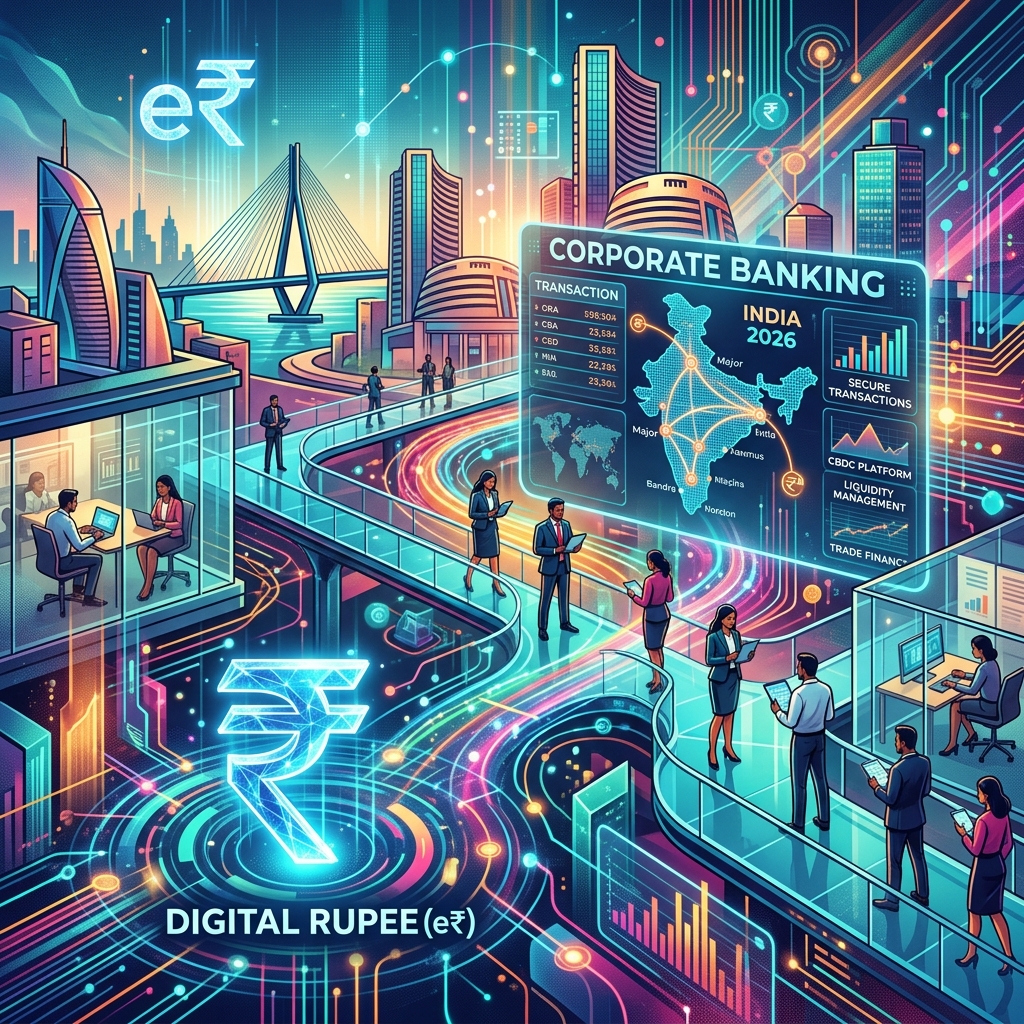
- What is the Digital Rupee (e-Rupee)?
- CBDC vs. NEFT/RTGS: Structural Differences
- Impact on Corporate Treasury & Working Capital
- Programmable Payments & Smart Escrows
- API Integration: ERPs, SAP & CBDC Nodes
- Cross-Border Corporate Settlements & mBridge
- Security, Liquidity & Risk Mitigation
- Programmable Escrows & Multi-Sig Corporate Wallets
- Liquidity Optimization: Real-time Cash Pooling
- Legal & Regulatory Compliance for Digital Settlements
- The Accounting & Treasury Disclosures for e-Rupee Holdings
- Future-Proofing Corporate Treasury: The Transition Roadmap
- Integrating e-Rupee with Cross-Border Trade Finance Platforms
- Cybersecurity Resilience & Private Key Management for Corporate Nodes
- Corporate Readiness Checklist for CBDC Integration
- Frequently Asked Questions
What is the Digital Rupee (e-Rupee)?
The global financial plumbing is undergoing a quiet but rapid transformation, and India is leading the charge with its Central Bank Digital Currency (CBDC)—the Digital Rupee (e-Rupee). Issued and backed by the Reserve Bank of India (RBI), the e-Rupee is a digital token that represents legal tender. When examining the impact of the digital rupee corporate banking india 2026 initiatives, corporate treasurers must look past the consumer retail pilots to the far more significant wholesale pilot programs.
The e-Rupee is not a cryptocurrency; it is sovereign currency in a digital format. It carries the exact same value and legal status as paper currency and is exchangeable at par with physical cash. The wholesale pilot (e-Rupee-W) was launched to settle interbank transactions, specifically targeting the secondary market transactions in government securities. By replacing traditional bank credit settlements with instant tokenized cash, the RBI is laying the groundwork for a zero-settlement-risk corporate banking ecosystem.
CBDC vs. NEFT/RTGS: Structural Differences
Corporate financial teams often ask: “Why do we need CBDC when we already have NEFT, RTGS, and IMPS running flawlessly?” The answer lies in the fundamental difference between “payment instructions” and “value settlement.”
| Feature | RTGS / NEFT Payments | e-Rupee (Wholesale CBDC) |
|---|---|---|
| Settlement Type | Deferred net settlement or gross settlement via bank ledgers. | Instant tokenized value settlement (Real-time Finality). |
| Counterparty Risk | Exposed to commercial bank solvency risk during transit. | Zero bank risk (Direct sovereign liability). |
| Clearing Intermediaries | Requires clearing corporations, settlement banks, and messaging hubs. | Peer-to-peer settlement without intermediate clearing. |
| Programmability | Requires complex external escrows and manual legal oversight. | Self-executing smart contracts built into the currency. |
Impact on Corporate Treasury & Working Capital
For corporate treasurers managing multi-billion rupee operations, working capital optimization is a daily struggle. A significant portion of corporate cash is constantly trapped in clearing cycles, inter-bank float, and clearing settlements.
The digital rupee corporate banking india 2026 framework changes this landscape by enabling instant settlement finality (T-0). When a corporate buyer pays a supplier using e-Rupee, the value is transferred instantly, bypassing clearing cycles. This eliminates the need for maintaining heavy buffer balances to cover clearing settlement delays. Treasurers can operate with lower liquidity reserves, freeing up capital to be deployed in overnight yield-generating instruments or to fund real-time supply chain operations.
Programmable Payments & Smart Escrows
The most disruptive feature of wholesale CBDC is “programmability”—the ability to attach smart contracts directly to the digital currency. This allows corporations to automate cash flows based on specific real-world conditions.
This programmable cash logic eliminates the need for expensive third-party escrow accounts and complex bank guarantees. It reduces transaction execution times from weeks to seconds, bringing unprecedented velocity to corporate supply chain financing (for a detailed operational manual on this, read our Supply Chain Financing Guide).
API Integration: ERPs, SAP & CBDC Nodes
For large-scale corporate adoption, the e-Rupee must integrate seamlessly with existing enterprise resource planning (ERP) systems like SAP and Oracle. This is achieved through secure API banking interfaces.
Under the digital rupee corporate banking india 2026 integration protocols, banks provide specialized CBDC gateway APIs. These APIs allow corporate ERP systems to directly communicate with the bank’s digital rupee nodes. A payment request approved in SAP can automatically generate a signed digital token payload, transmit it to the bank’s node, and execute the settlement instantly. This removes manual file uploads, batch payment runs, and payment gateway latency, creating a direct, programmatic bridge between business operations and the sovereign ledger.
Cross-Border Corporate Settlements & mBridge
Cross-border payments remain slow, expensive, and opaque, heavily dependent on correspondent banking networks and SWIFT messaging. RBI’s wholesale e-Rupee pilot is designed to revolutionize this through integration with multi-CBDC platforms like the mBridge project.
By connecting India’s e-Rupee ledger with the digital currency ledgers of partner central banks (such as the UAE, Hong Kong, and China), multinational corporations can settle cross-border trade transactions in local currencies instantly. A manufacturer in Chennai can import components from Shenzhen and settle the payment in digital Renminbi or digital Rupees in real-time, completely bypassing correspondent bank charges, multiple currency conversions, and settlement risk. This represents a seismic shift for exporters and importers managing global supply chains.
Programmable Escrows & Multi-Sig Corporate Wallets
The introduction of programmable escrows directly onto the CBDC ledger represents a quantum leap in corporate risk management. In traditional corporate banking, setting up an escrow account for a major acquisition or a high-value real estate transaction involves complex tripartite agreements, high bank fees, and weeks of administrative delay. Under the digital rupee corporate banking india 2026 framework, corporate treasurers can execute these transactions programmatically using smart contracts. The e-Rupee tokens are deposited into a secure, multi-signature corporate wallet where they are locked. The smart contract is programmed to release the funds to the seller’s wallet only upon the digital verification of pre-agreed conditions, such as the registration of the title deed or the clearance of regulatory approvals. This removes the administrative overhead and intermediate clearing fees, ensuring that funds are transferred instantly and securely without any reliance on manual bank intervention.
Additionally, multi-sig wallet structures provide a robust safeguard against internal fraud and cyber threats. Corporate treasury wallets can be configured to require digital signatures from multiple authorized officers (e.g., the CFO, the Treasurer, and the Compliance Officer) before any high-value wholesale transaction can be initiated. These signatures are verified cryptographically on the CBDC network, rendering unauthorized transfers impossible. For large enterprises, integrating these secure, multi-sig wallets with their internal approval workflows is a critical step to secure their digital asset holdings and ensure absolute control over their sovereign digital currency capital.
Liquidity Optimization: Real-time Cash Pooling
For multinational corporations managing hundreds of bank accounts across various subsidiaries and geographical regions, optimizing liquidity is an ongoing challenge. Traditional cash pooling methods rely on end-of-day sweeps, which are slow, subject to intermediate clearing costs, and exposed to bank-level balance sheet limits. The wholesale e-Rupee completely alters this paradigm by enabling real-time cash pooling. Because e-Rupee transactions are settled instantly with T-0 finality, corporate treasuries can aggregate cash balances from different subsidiary wallets into a master corporate wallet in real-time, without waiting for the end-of-day clearing batch. This provides the corporate treasury with an instantaneous, unified view of the company’s global liquidity, allowing them to optimize interest yields and deploy cash dynamically to fund operational deficits as they arise.
Furthermore, real-time cash pooling reduces the company’s reliance on short-term overdraft facilities. In traditional banking, a subsidiary facing a temporary cash deficit during the day must draw on a bank overdraft, incurring interest charges, even if another subsidiary has a large surplus sitting in a different bank. With integrated digital rupee corporate banking india 2026 treasury nodes, the surplus cash of one subsidiary can be transferred to the deficit subsidiary instantly and costlessly, minimizing the net interest expense of the group. Implementing these real-time liquidity pools requires a robust API connection between the corporate ERP and the bank’s digital rupee network, allowing automated treasury systems to execute sweeps based on real-time balance fluctuations.
Legal & Regulatory Compliance for Digital Settlements
Navigating the legal and regulatory framework governing digital rupee transactions is a critical requirement for corporate compliance officers. Under the Reserve Bank of India Act, 1934, amendments were introduced to recognize the CBDC as legal tender on par with physical currency notes. This ensures that any corporate debt or liability can be legally discharged using e-Rupee, and no commercial entity can refuse to accept it as payment. However, because the e-Rupee is digital, it leaves an immutable cryptographic trail on the RBI’s ledger. Corporate compliance teams must ensure that their digital rupee transactions are fully aligned with the Prevention of Money Laundering Act (PMLA) and FEMA guidelines, particularly for cross-border transactions executed via multi-CBDC networks like mBridge.
Moreover, the cybersecurity requirements for corporate wallets are extremely stringent. The RBI mandates that commercial banks offering digital rupee services must enforce multi-factor authentication and strict encryption standards on all corporate client interfaces. Corporate treasuries must audit their internal IT infrastructure to ensure that the private keys to their digital wallets are stored in secure Hardware Security Modules (HSMs) and are protected by robust access control policies. Any compromise of the private keys can result in irreversible loss of digital rupee tokens, as the central bank cannot roll back or reverse transactions on the cryptographic ledger. Implementing these robust cyber-resilience policies is essential to defend against sophisticated threats under the digital rupee corporate banking india 2026 ecosystem.
The Accounting & Treasury Disclosures for e-Rupee Holdings
The treatment of e-Rupee holdings under Indian Accounting Standards (Ind AS) requires careful classification by corporate finance teams. Since the Digital Rupee is issued by the central bank and represents sovereign legal tender, it is classified under ‘Cash and Cash Equivalents’ on the corporate balance sheet, unlike cryptocurrencies which are treated as intangible assets or inventory. This classification ensures that holding e-Rupee does not trigger any fair value adjustments or impairment testing, simplifying the accounting process. However, because e-Rupee is held in digital wallets rather than commercial bank accounts, the treasury must disclose these digital currency holdings separately in the footnotes to the financial statements, detailing the name of the bank managing the wallet node and the volume of tokens held at the end of the financial year.
Additionally, corporate tax teams must evaluate the tax implications of transactions settled in e-Rupee. While the medium of payment does not alter the underlying tax liability (GST and Income Tax apply normally), the instant settlement finality can impact the timing of tax recognition. For instance, in real-time supply chain financing settled via programmable e-Rupee, the tax invoice must be generated and GST liability recognized at the exact timestamp the smart contract executes the payment and triggers the delivery. This requires real-time synchronization between the ERP’s billing module and the tax compliance engine to prevent any timing mismatches or delays in tax filings (which could trigger scrutiny and require defense strategies like those in our Faceless Appeals Guide) under the digital rupee corporate banking india 2026 guidelines.
Future-Proofing Corporate Treasury: The Transition Roadmap
To secure a competitive advantage in the digital direct economy, forward-looking corporations must begin preparing their treasury systems for CBDC integration today. The transition from traditional bank transfers to tokenized central bank money requires a phased roadmap. In the initial phase, companies should coordinate with their primary commercial banks to participate in the ongoing wholesale e-Rupee pilots, setting up test wallets to settle inter-company and secondary market transactions. This allows the treasury team to build operational familiarity with digital wallets, private key management, and cryptographic transaction verification.
In the second phase, the focus must shift to ERP integration. Corporate IT teams must work with ERP providers to deploy specialized API adapters that connect SAP or Oracle with the bank’s digital rupee gateway. This enables the automation of high-volume payments, programmable escrows, and real-time cash pooling. Finally, in the third phase, the company can expand CBDC settlements to its broader supply chain, onboarding Tier-1 and Tier-2 suppliers onto the digital rupee network. By establishing this integrated, digital direct treasury ecosystem, corporations can minimize transaction latency, reduce credit risks, and optimize their working capital efficiency under the digital rupee corporate banking india 2026 roadmap.
Integrating e-Rupee with Cross-Border Trade Finance Platforms
The integration of the Digital Rupee with global trade finance platforms represents a vital growth corridor for Indian exporters. Traditional trade finance relies heavily on letters of credit (LCs) and documentary collections, which are slow, paper-based, and require manual checking by multiple banks. By linking the RBI’s wholesale CBDC network with digital bill-of-lading systems and blockchain-based trade platforms (such as Contour or Marco Polo), the entire import-export cycle can be automated. A shipment verified via electronic bill of lading can instantly trigger a smart-contract-based e-Rupee payment, completing cross-border settlements in seconds instead of days.
Furthermore, this integration significantly reduces trade disputes and fraud risks. Because the payment is programmatically linked to verified shipping data, there is no risk of dual-financing or non-delivery. Exporters can access immediate liquidity by pledging their programmable e-Rupee escrows to financing institutions, lowering their borrowing costs and improving their cash conversion cycles. Multinationals operating in India must closely monitor these cross-border pilot programs and design their treasury systems to interface with multi-CBDC networks, ensuring they are ready to adopt tokenized trade settlements under the digital rupee corporate banking india 2026 evolution.
Cybersecurity Resilience & Private Key Management for Corporate Nodes
As corporations shift from traditional online banking to cryptographic CBDC wallets, they must completely overhaul their cybersecurity infrastructure. In traditional banking, an unauthorized transfer can often be recalled or blocked by the bank if reported immediately. However, e-Rupee transactions are cryptographically signed and settled directly on the central bank’s ledger, achieving instant, legally irreversible finality. This makes private key protection the single most critical task for corporate IT security teams, as any compromise of the private keys results in immediate and permanent loss of capital.
To mitigate this risk, corporations must store their wallet private keys in dedicated, FIPS-compliant Hardware Security Modules (HSMs) rather than software databases or cloud servers. HSMs ensure that the private keys can never be exported or copied, executing the cryptographic transaction signatures inside a secure, tamper-proof environment. Furthermore, companies must enforce strict role-based access control (RBAC) and multi-signature authorization rules, requiring digital approvals from multiple treasury officers before any transaction can be processed. Implementing these robust security protocols is a non-negotiable prerequisite to protect corporate assets in the digital rupee corporate banking india 2026 era.
In addition to physical key protection, corporate security directors must establish robust key recovery and lifecycle management policies. In the event of a system failure or disaster recovery scenario, the corporate treasury must be able to restore access to its digital wallets without exposing the private keys to external networks. This requires utilizing secure key-sharding schemes, such as Shamir’s Secret Sharing, where the master recovery key is split into multiple pieces held by different designated trustees. Reassembling the key requires a predetermined threshold of trustees to be present, ensuring that no single individual can unilaterally access or compromise the recovery process. Regular backup audits and disaster recovery drills must be executed quarterly to verify that the recovery protocols function flawlessly under stress, minimizing operational downtime and ensuring continuous business operations in the digital rupee corporate banking india 2026 financial environment.
“The transition from commercial bank money to tokenized central bank money is the most significant evolution in corporate finance since the invention of double-entry bookkeeping. Instant finality and programmability will rewrite working capital strategies.”
- ✓Coordinate with your primary transaction bank to open corporate e-Rupee wholesale wallets.
- ✓Install dedicated Hardware Security Modules (HSMs) in your datacenter to store wallet private keys.
- ✓Configure multi-signature approval rules in the corporate directory (AD) for transactions over designated limits.
- ✓Develop SAP or Oracle API connectors to fetch real-time wallet balances and execute payment orders.
- ✓Establish an accounting policy under Ind AS for separating e-Rupee holdings from commercial bank deposits.
- ✓Draft updated supplier contracts with terms enabling tokenized delivery-vs-payment (DvP) settlements.
- ✓Train treasury staff on cryptographic transaction verification and portal administration dashboard tools.
Corporate Readiness Checklist for CBDC Integration
Transitioning from traditional clearing bank systems to tokenized central bank money requires a coordinated effort between IT, Treasury, Legal, and Compliance departments. A structured roadmap is essential to avoid operational disruptions during integration.
For Treasury Managers: Focus on setting up liquidity rules. e-Rupee wallets do not pay interest (to prevent bank disintermediation). Therefore, the treasury must configure automated rules to sweep any excess end-of-day digital rupee balances back into interest-yielding commercial bank deposits or liquid mutual funds.
For Legal Counsels: Update vendor agreement templates. Contracts must define the exact digital receipt (e.g. ERP proof-of-delivery timestamp) that triggers the smart contract execution. Clear clauses on dispute resolution and rollback protocols in case of delivery disputes are crucial to manage risk under digital rupee corporate banking india 2026 structures.
Frequently Asked Questions on digital rupee corporate banking india 2026
Does holding Digital Rupee (e-Rupee) in corporate wallets earn interest?
What is the difference between e-Rupee-R and e-Rupee-W?
How is the Digital Rupee classified on a corporate balance sheet?
How does a smart contract work with the Digital Rupee?
What is the mBridge project in relation to the e-Rupee?
Can a corporate buyer reverse an e-Rupee transaction once executed?
What security measures are required to protect corporate digital wallets?
How does CBDC impact supply chain financing for manufacturers?
- Wholesale e-Rupee Wallet Architecture Setup
- ERP (SAP/Oracle) API Node Integration
- Multi-Sig Security & Private Key Policy
- Cross-Border mBridge Trade Advisory