
GST E-Way Bill Compliance 2026: Complete Expert Guide for Transporters & Businesses
- What is GST E-Way Bill? The Complete Overview
- Threshold Limit & When E-Way Bill is Mandatory
- How to Generate an E-Way Bill: Step-by-Step
- E-Way Bill Validity Period & Extension Rules 2026
- Part B Updating & Vehicle Change Rules
- Goods & Transactions Exempt from E-Way Bill
- Penalties for Non-Compliance: The Full Picture
- Special Rules for Transporters & GTA
- E-Way Bill vs E-Invoice: How They Work Together
- Frequently Asked Questions
What is GST E-Way Bill? The Complete Overview
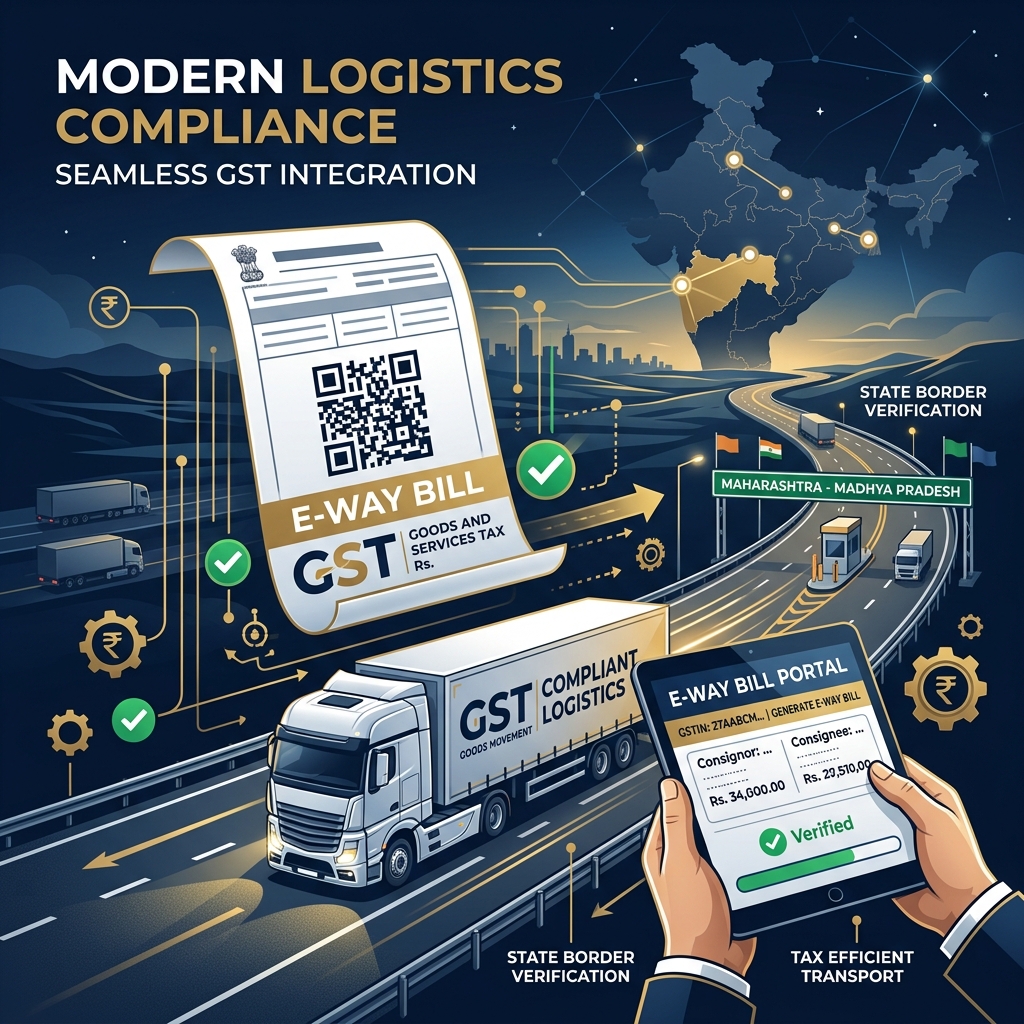
The GST E-Way Bill (Electronic Way Bill) is a mandatory electronic document that must accompany every consignment of goods worth more than ₹50,000 during movement across India. It is generated on the government portal ewaybillgst.gov.in and serves as proof that the GST on the transported goods has been paid or acknowledged. Proper gst e-way bill compliance 2026 is non-negotiable for every transporter, supplier, and recipient in India’s goods supply chain.
Introduced on April 1, 2018, the E-Way Bill system replaced the old State-level waybill and Form 402/403 systems. Today, it is fully integrated with the GST return filing ecosystem. A missing or incorrect E-Way Bill during vehicle interception by a GST officer can lead to seizure of goods, confiscation of the vehicle, and a penalty equal to the tax evaded — which could be lakhs of rupees for a single consignment.
The E-Way Bill has two parts: Part A contains the consignment details (supplier GSTIN, recipient GSTIN, goods description, HSN code, value, and reason for transport), and Part B contains the vehicle/transport details (vehicle number, transporter ID). Part A can be generated by the supplier, recipient, or transporter. Part B must be updated by whoever is in physical possession of the goods during transport.
Threshold Limit & When E-Way Bill is Mandatory
Understanding exactly when you need an E-Way Bill is the foundation of gst e-way bill compliance 2026. The rules differ based on the type of movement, the value of goods, and the mode of transport.
| Type of Movement | E-Way Bill Required? | Threshold Value |
|---|---|---|
| Inter-State Supply (any mode) | Yes — Mandatory | Above ₹50,000 |
| Intra-State Supply | Depends on State | Varies (most states: ₹50,000+) |
| Job Work (inter-state) | Yes — Mandatory | Above ₹50,000 |
| Non-Supply Movement (own stock transfer) | Yes — Mandatory | Above ₹50,000 (treated as supply) |
| Rail/Air/Ship Transport | Yes (Part B can be updated later) | Above ₹50,000 |
| Handcarriage (distance less than 50km) | Conditionally Exempt | Check state-specific rules |
A critical update for gst e-way bill compliance 2026: several states have raised their intra-state thresholds. For example, Maharashtra requires an E-Way Bill only for intra-state movement above ₹1 lakh. Always verify the specific threshold for the originating state before dispatching goods, as using the wrong threshold is itself a compliance failure.
How to Generate an E-Way Bill: Step-by-Step
Generating an E-Way Bill correctly is the most operationally critical part of gst e-way bill compliance 2026. Here is the complete step-by-step process:
- Bulk Upload: Upload a JSON/Excel file to generate multiple E-Way Bills in one go.
- API Integration: Integrate your ERP (SAP, Tally, Zoho) directly with the E-Way Bill API for automatic generation on invoice creation. This is the gold standard of gst e-way bill compliance 2026 for large enterprises.
- SMS-Based Generation: For transporters in low-connectivity areas, basic E-Way Bill generation is also possible via SMS to 7738299899.
E-Way Bill Validity Period & Extension Rules 2026
One of the most operationally critical aspects of gst e-way bill compliance 2026 is understanding validity periods. An expired E-Way Bill during transit is treated the same as having no E-Way Bill at all, making vehicle interception grounds for penalty and detention.
| Cargo Type | Distance | Validity Period |
|---|---|---|
| Normal Cargo (Road) | Up to 200 km | 1 Day |
| Normal Cargo (Road) | Every additional 200 km | +1 Day |
| Over-Dimensional Cargo (ODC) | Up to 20 km | 1 Day |
| Over-Dimensional Cargo (ODC) | Every additional 20 km | +1 Day |
| Goods transported by Rail | Any distance | 15 Days |
| Goods transported by Air | Any distance | 15 Days |
| Goods transported by Vessel | Any distance | 15 Days |
For road transport, the 1-day validity begins from the moment of generation (not the invoice date). For goods moving from Mumbai to Delhi (approximately 1,400 km), the E-Way Bill will be valid for 7 days (1,400 ÷ 200 = 7). If the vehicle breaks down or faces a natural disaster or trans-shipment delay, the transporter can extend the E-Way Bill via the portal before it expires — but NOT after expiry. This is a critical gst e-way bill compliance 2026 rule that catches many businesses off guard.
Part B Updating & Vehicle Change Rules
Part B of the E-Way Bill contains vehicle/transport details. Keeping Part B current is a core requirement of gst e-way bill compliance 2026, especially for goods that change vehicles during transit (trans-shipment).
- Vehicle breakdown: Goods transferred to another vehicle — Part B must be updated before the new vehicle moves.
- Trans-shipment: Goods offloaded at a warehouse and reloaded on a different vehicle — update Part B at each vehicle change.
- Mode change: Goods move from road to rail — the transporter updates Part B with the rail/RR number.
- Transporter change: A different logistics company takes over — the new transporter updates Part B.
Goods & Transactions Exempt from E-Way Bill
Not every goods movement requires an E-Way Bill. Schedule to Rule 138 of CGST Rules 2017 specifies exempt categories. Knowing these exemptions is as important as knowing the obligations, for efficient gst e-way bill compliance 2026.
| Exempt Category | Details |
|---|---|
| Exempt Goods | Fresh fruits & vegetables, milk, curd, bread, salt, newspapers, printed books, unprocessed food grains |
| Non-motorised transport | Goods moved by non-motorised conveyance (cycle, handcart, animal-drawn cart) |
| Customs bonded movement | Goods under customs seal from port to ICD/CFS under customs supervision |
| Defence movement | Goods transported by or to the Ministry of Defence |
| Empty cargo containers | Movement of empty transport containers |
| Short distance (50 km) | Movement of goods from the place of business of the consignor to a weighbridge within 20 km (for weight measurement) |
Penalties for Non-Compliance: The Full Picture
The penalty provisions for E-Way Bill violations under gst e-way bill compliance 2026 are severe and carry both monetary and physical consequences. Section 129 (detention and seizure) and Section 130 (confiscation) of the CGST Act apply.
| Violation | Penalty |
|---|---|
| Movement without E-Way Bill | Penalty = higher of: (a) 200% of tax due on goods, or (b) ₹10,000 |
| Expired E-Way Bill | Same as above — treated as movement without EWB |
| Mismatch in goods description | Penalty + possible seizure of goods + vehicle detention |
| Incorrect vehicle number in Part B | Penalty of ₹10,000 per consignment |
| Transporter not carrying EWB copy | Penalty of ₹10,000 |
| Goods seized and owner untraceable | Goods confiscated; disposal by GST authority |
Special Rules for Transporters & GTA: gst e-way bill compliance 2026 Essentials
Goods Transport Agencies (GTAs) and individual transporters have specific obligations under gst e-way bill compliance 2026 that go beyond what the supplier/recipient must do. If a supplier fails to generate an E-Way Bill, the transporter who carries goods worth more than ₹50,000 without one is equally liable for the penalty.
- TRAN-ID Registration: Transporters who are not GST-registered must enroll on the E-Way Bill portal to get a 15-digit Transporter ID (TRAN-ID). This is mandatory to be named as the transporter in Part B.
- Consolidated E-Way Bill (CEWB): If a single vehicle carries goods belonging to multiple consignments (LCL — Less than Container Load), the transporter must generate a Consolidated E-Way Bill linking all individual EWBs for that vehicle trip.
- Multi-modal transport: In multi-modal shipments, each carrier must update Part B when they take custody of the goods.
- Verification duty: Transporters must verify that the E-Way Bill details match the actual goods in the consignment before accepting the shipment. Accepting a mismatched consignment creates joint liability.
E-Way Bill vs E-Invoice: How They Work Together in 2026
A common point of confusion in gst e-way bill compliance 2026 is the relationship between E-Way Bills and E-Invoices. These are two separate systems that now work in integration for businesses above the applicable turnover threshold.
| Parameter | E-Invoice | E-Way Bill |
|---|---|---|
| Purpose | Validates the B2B invoice with IRN | Tracks physical movement of goods |
| Threshold (2026) | Turnover above ₹5 crore | Consignment value above ₹50,000 |
| Generated by | Supplier only | Supplier, recipient, or transporter |
| Auto-population | Part A of E-Way Bill auto-populated from E-Invoice | Part B still needs manual entry |
| Portal | einvoice1.gst.gov.in | ewaybillgst.gov.in |
| Validity | IRN valid for 24 hours for cancellation only | Distance-based validity (1–15 days) |
The most important integration for gst e-way bill compliance 2026: if you are generating an E-Invoice for a B2B supply that involves goods movement above ₹50,000, the E-Invoice portal will automatically push Part A data to the E-Way Bill portal. You only need to add vehicle details in Part B. This eliminates double data entry and reduces errors — but it requires that your IRN (Invoice Reference Number) is generated before the goods leave the premises.
State-Wise E-Way Bill Rules & Intra-State Thresholds 2026
While the central CGST rules set a ₹50,000 threshold for inter-state movement, each state has the power to set its own intra-state E-Way Bill threshold under SGST rules. Knowing these state-specific rules is a critical component of gst e-way bill compliance 2026 for businesses operating across multiple states.
| State | Intra-State EWB Threshold | Special Notes |
|---|---|---|
| Maharashtra | ₹1,00,000 | Higher threshold for intra-state only |
| Delhi | ₹1,00,000 | Notified threshold for intra-state supply |
| Karnataka | ₹50,000 | Follows central threshold; strict enforcement |
| Tamil Nadu | ₹1,00,000 | Higher relief for local traders |
| Gujarat | ₹50,000 | Standard central threshold applies |
| Rajasthan | ₹1,00,000 | Relief notification issued for intra-state |
| Uttar Pradesh | ₹50,000 | Standard central threshold; high interception activity |
| West Bengal | ₹1,00,000 | Follows enhanced threshold |
Always verify the current threshold notification for the specific state by checking the respective state’s GST department website, as thresholds are periodically revised. For gst e-way bill compliance 2026, businesses operating in multiple states should configure their ERP systems with state-specific thresholds to automatically trigger EWB generation only when required.
Best Practices to Automate gst e-way bill compliance 2026
Manual E-Way Bill generation is error-prone and time-consuming, especially for businesses dispatching hundreds of orders daily. Automating your gst e-way bill compliance 2026 workflow is no longer optional for medium and large businesses — it is a compliance necessity.
- SAP: SAP S/4HANA integrates directly with the EWB API through standard GST connectors
- Tally Prime: Tally has built-in E-Way Bill integration that auto-generates EWB on invoice creation
- Zoho Books: Cloud-based EWB generation triggered automatically on GST invoice creation
- Custom ERP: Use the NIC-provided API documentation to build custom integrations for your logistics management system
- Every invoice above threshold has a corresponding EWB
- EWB values match invoice values (no splitting detected)
- All cancelled EWBs have corresponding credit notes
- Transporter IDs in Part B match your logistics vendor records
Finally, train all your dispatch staff, accounts team, and logistics coordinators on E-Way Bill rules. A common failure point in gst e-way bill compliance 2026 is when one department generates the invoice and another handles dispatch, with neither having full ownership of the EWB generation process. Assign a clear responsible person for EWB compliance in your organisation, supported by automated systems and regular internal audits.
E-Way Bill Interception & Your Rights During Vehicle Inspection
Understanding what happens during a GST vehicle interception is one of the most practically valuable aspects of gst e-way bill compliance 2026. GST officers (both state and central) have the power to intercept vehicles carrying goods and inspect the E-Way Bill, physical goods, and related documents. Here is exactly what to expect and how to respond.
- Request the officer’s identity proof before complying with any direction
- Receive a written order for detention (FORM GST MOV-06) specifying reasons
- Be given a reasonable opportunity to explain any discrepancies before penalty is imposed
- File an appeal against any penalty order before the Appellate Authority within 3 months
- Claim that the discrepancy was a bona fide mistake (minor errors in vehicle number, etc.) and seek minimal penalty of ₹10,000 instead of the full tax-based penalty
Investing in robust gst e-way bill compliance 2026 systems — automated generation, validity monitoring, staff training, and monthly reconciliation — pays for itself many times over by eliminating the risk of vehicle detentions, penalty orders, and the reputational damage that comes from delayed deliveries due to GST interceptions. Make E-Way Bill compliance a boardroom-level priority, not an afterthought.
Frequently Asked Questions on GST E-Way Bill Compliance 2026
Can an unregistered person generate an E-Way Bill?
What happens if the E-Way Bill is cancelled?
Is E-Way Bill required for exports?
What is the Consolidated E-Way Bill (CEWB) and when is it needed?
Do I need a separate E-Way Bill for each invoice in a single truck?
What if the E-Way Bill has a wrong HSN code?
- EWB Generation Help
- Penalty Defence
- Detention Release
- Compliance Audit