
Tax Implications of ESOPs under the New Tax Regime 2026
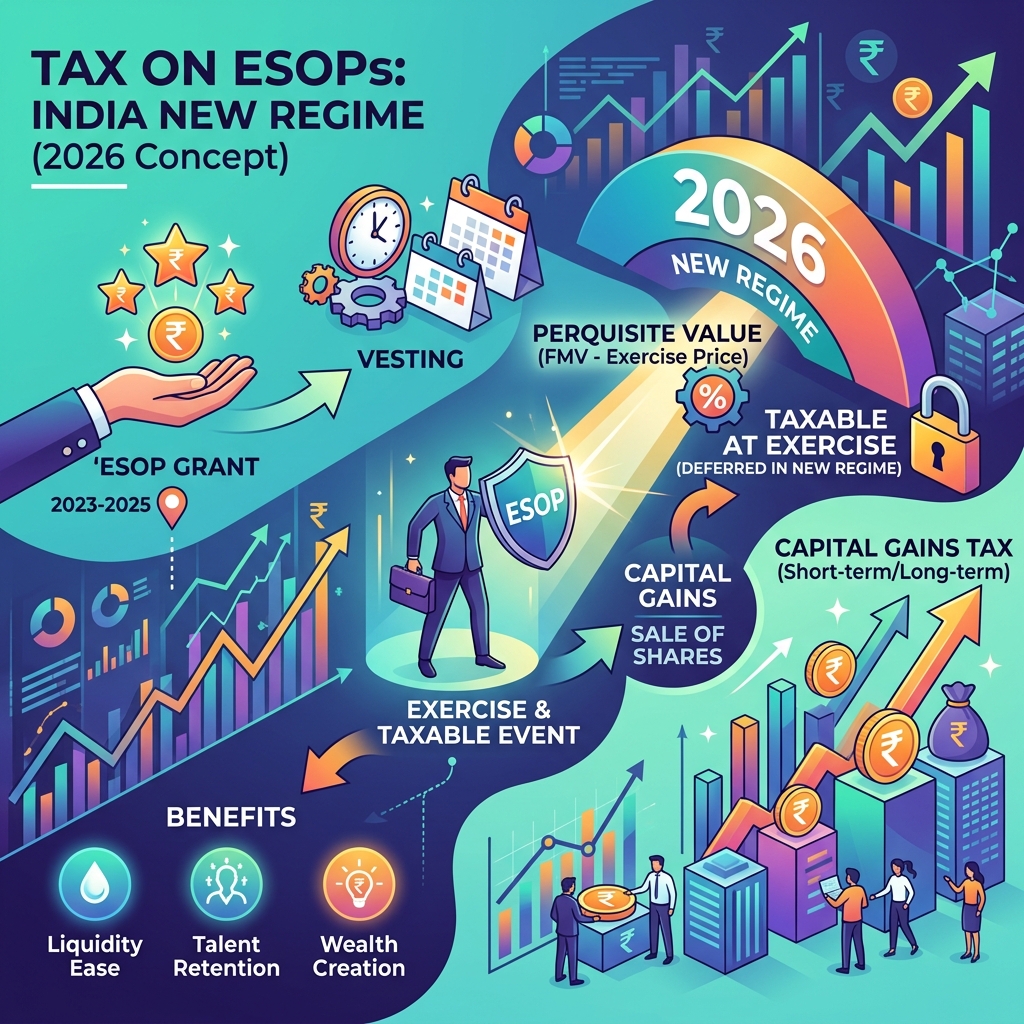
- The Dual Taxation Stages of ESOPs
- The New Tax Regime 2026: Revised Slab Rates
- Calculating the Perquisite Tax on Exercise
- The Deferral Benefit for Registered Startups
- Capital Gains Tax on Sale of ESOP Shares
- Old vs. New Tax Regime: Strategic Comparison
- Managing the Tax Outflow: Cashless Exercise Options
- Section 80-IAC Startup Deferrals and trigger points
- Surcharge Optimization for HNIs under the New Regime
- Double Taxation Relief: Form 10EE and Section 90/91 Claims
- The Impact of Cashless Exercise on Tax Compliance
- Future-Proofing Your ESOP Portfolio: Post-Exercise Audit trail
- Evaluating the Tax Impact of ESOP Liquidity Events (Buybacks vs. IPOs)
- FEMA Compliance and RBI Guidelines for Foreign Parent ESOPs
- Tax Planning Checklist for Exercising ESOPs
- Frequently Asked Questions
The Dual Taxation Stages of ESOPs
Employee Stock Option Plans (ESOPs) are a highly effective tool for attracting and retaining top-tier talent in India (for details on startup structuring, see our guide on ESOP Structuring India 2026). However, the financial benefit of ESOPs can be significantly impacted by their tax treatment. Under the Income Tax Act, 1961, ESOPs are subject to tax at two distinct stages: at the time of exercise (as salary income) and at the time of sale (as capital gains). Understanding the nuances of tax on esops new tax regime india 2026 is essential for employees to optimize their tax liabilities and avoid cash flow crises.
The first tax trigger occurs on the “date of exercise,” which is when the employee converts their vested options into actual shares. The second tax trigger occurs when the employee eventually sells those shares. Because these two stages operate under different tax heads and timelines, failing to plan for the tax liabilities on exercise can lead to severe cash flow mismatches.
The New Tax Regime 2026: Revised Slab Rates
With the New Tax Regime becoming the default tax regime in India, taxpayers must evaluate their ESOP tax liabilities under the revised slab rates. The New Tax Regime features lower slab rates but does not allow major deductions (like Section 80C, 80D, or House Rent Allowance).
For high-earning corporate employees, the New Tax Regime’s lower rates can result in significant tax savings on the perquisite value. The tax brackets under the New Tax Regime are structured with six income slabs, capping the maximum marginal tax rate at 30% for taxable income exceeding ₹15 Lakhs (with a reduced surcharge cap of 25% for high-net-worth individuals). Evaluating the perquisite tax under this default regime is critical when planning the timing of your ESOP exercise under the tax on esops new tax regime india 2026 framework.
Calculating the Perquisite Tax on Exercise
To calculate the perquisite tax, the employer must determine the Fair Market Value (FMV) of the shares on the date of exercise. The method to determine the FMV differs based on whether the company is listed or unlisted.
For listed companies, the FMV is simply the average of the opening and closing price of the shares on the stock exchange on the date of exercise. For unlisted companies, the FMV must be determined by a Category-I Merchant Banker registered with SEBI. The employer is legally mandated to deduct Tax Deducted at Source (TDS) on this perquisite value, and the employee must pay this tax immediately, even though the shares are illiquid and cannot be sold on the open market, creating a significant tax barrier under the tax on esops new tax regime india 2026 rules.
The Deferral Benefit for Registered Startups
Recognizing the cash flow challenge faced by startup employees (who are taxed on illiquid shares on the date of exercise), the government introduced a major relief program under Section 156(2) of the Income Tax Act.
For employees of registered startups that qualify under Section 80-IAC, the payment of perquisite tax on ESOPs is deferred. The tax payment is deferred to the earliest of the following three events: 5 years from the date of exercise, the date the employee resigns or leaves the company, or the date the employee sells the shares. This deferral allows employees to avoid paying tax upfront on illiquid shares, aligning the tax cash outflow with an actual liquidity event.
Capital Gains Tax on Sale of ESOP Shares
When the employee eventually sells the shares, they are subject to Capital Gains tax. The calculation of capital gains depends on the holding period and the listed status of the shares.
| Share Category | Holding Period for LTCG | LTCG Rate | STCG Rate |
|---|---|---|---|
| Listed Equity Shares | Exceeding 12 Months. | 10% (exemption up to ₹1.25L). | 15% (under Section 111A). |
| Unlisted / Startup Shares | Exceeding 24 Months. | 20% (with indexation benefits). | Taxed at employee’s slab rate. |
Old vs. New Tax Regime: Strategic Comparison
Choosing between the Old and New Tax Regime for a year in which you exercise high-value ESOPs requires careful tax planning. Because the perquisite value is added directly to your taxable salary, it can push you into the highest tax bracket instantly.
For high-value exercises, the New Tax Regime is often the more tax-efficient option due to the lower slab rates and the reduced surcharge cap of 25% (down from 37% in the old regime). This surcharge reduction is highly valuable for corporate executives whose total income (including the ESOP perquisite value) exceeds ₹5 Crores, helping them save lakhs in tax under the default tax on esops new tax regime india 2026 guidelines.
Managing the Tax Outflow: Cashless Exercise Options
To help employees fund the perquisite tax liability without liquidating their personal savings, many companies offer structured “cashless exercise” programs.
Under a cashless exercise scheme, a broker sells a portion of the exercised shares on the stock exchange instantly on the date of exercise to cover both the exercise price and the estimated perquisite tax liability. The remaining shares are then deposited into the employee’s demat account. This cashless route eliminates the need for any upfront cash outflow, resolving the liquidity mismatch and ensuring smooth compliance under the tax on esops new tax regime india 2026 framework.
Section 80-IAC Startup Deferrals and trigger points
The deferral of ESOP perquisite tax under Section 156(2) represents a critical tax-planning tool for startup employees in India. However, the legal mechanics of this deferral contain several hidden trigger points that can catch taxpayers off guard. The deferral is strictly limited to employees of startups that hold a valid certificate of registration from the Inter-Ministerial Board of Certification under Section 80-IAC of the Income Tax Act. A common misconception is that any startup registered with DPIIT qualifies for the deferral. If the employer DPIIT startup does not hold the specific IMB approval, the deferral is invalid, and the employee must pay perquisite tax on the date of exercise. For practitioners managing tax on esops new tax regime india 2026, verifying the employer’s Section 80-IAC status before exercising options is a vital risk mitigation step.
Additionally, the deferral automatically terminates upon the employee’s resignation or termination from the company. The moment the employment relationship ceases, the deferred tax liability is triggered, and the company must deduct TDS on the perquisite value within fourteen days, even if the shares remain completely illiquid and the five-year deferral window is still open. This can create a severe financial crisis for employees who leave a startup before a liquidity event (like an IPO or buyback) occurs, as they must find the cash to pay the tax demand immediately. Founders and tax advisors must design exit compensation packages carefully to help departing employees manage these sudden tax liabilities.
Surcharge Optimization for HNIs under the New Regime
For senior executives and founders whose taxable income exceeds ₹2 Crores, optimizing the surcharge rate is a primary goal. The New Tax Regime introduced a significant concession by capping the maximum surcharge rate at twenty-five percent, compared to the thirty-seven percent surcharge applicable under the Old Tax Regime. Since high-value ESOP exercises can easily push an executive’s total taxable income past the ₹5 Crore threshold, the difference in surcharge rates can result in massive tax savings. Under the New Tax Regime, the effective maximum marginal tax rate is reduced from forty-two point seven percent to thirty-nine percent, saving executives lakhs of rupees in tax outflows.
To maximize these savings, executives must coordinate the timing of their ESOP exercise with their other income streams. If an executive expects to receive a significant performance bonus or capital gains from other investments in a particular financial year, they should evaluate whether exercising their ESOPs in a lower-income year will help them stay within a lower surcharge bracket. Corporate tax teams must perform detailed comparative modeling, projecting the executive’s total taxable income under both regimes to ensure the exercise is executed at the absolute peak of tax efficiency under the tax on esops new tax regime india 2026 rules.
Double Taxation Relief: Form 10EE and Section 90/91 Claims
Double taxation represents a significant risk for Indian employees working in multinational corporations who receive stock options from a foreign parent entity. In many cases, the foreign country (such as the US or UK) may levy tax on the stock options at the time of vest or exercise, while India concurrently taxes the same transaction as a salary perquisite. To mitigate this double taxation, employees must leverage the Double Taxation Avoidance Agreements (DTAA) signed by India under Section 90 of the Income Tax Act. The taxpayer must claim foreign tax credit (FTC) in their Indian tax return, filing Form 67 electronically along with the proof of tax payment in the foreign jurisdiction.
Furthermore, under the recent CBDT guidelines, taxpayers must file the FTC claim before the due date for filing the return of income under Section 139(1). Any delay or error in filing Form 67 can result in the tax department rejecting the FTC claim, exposing the taxpayer to double taxation. Tax advisors must guide employees through the foreign tax reporting requirements carefully, ensuring that the income disclosed in the foreign tax return matches the perquisite value reported in Form 16 to secure seamless relief under the tax on esops new tax regime india 2026 framework.
The Impact of Cashless Exercise on Tax Compliance
While cashless exercise programs provide an excellent liquidity solution for employees, they introduce complex compliance requirements for the corporate payroll team. In a cashless exercise, the broker sells a portion of the shares instantly to cover the exercise price and the TDS liability. The payroll team must ensure that the sale is executed precisely on the date of exercise, and that the TDS is calculated on the exact FMV, not the actual sale price achieved by the broker. Any discrepancy between the FMV used for perquisite calculation and the actual sale price must be reconciled and reported as capital gains or losses in the employee’s tax filing.
Additionally, for unlisted startups, executing a cashless exercise is far more complex due to the lack of an active secondary market. Unlisted startups must establish internal liquidity pools or coordinate with angel investors to facilitate the instant purchase of the employee’s shares on the date of exercise. The company must draft detailed cashless exercise regulations, ensuring that the valuation used for the share transaction is backed by a Category-I Merchant Banker’s certificate to satisfy both ROC and Income Tax audit requirements under the tax on esops new tax regime india 2026 rules.
Future-Proofing Your ESOP Portfolio: Post-Exercise Audit trail
Maintaining an immutable compliance log is the final, essential step to future-proof your ESOP portfolio. The Income Tax Department can reopen tax assessments for up to six years if they suspect any underreporting of income or perquisite value. Taxpayers must archive all documentation related to their ESOPs—including the original grant letter, the vesting schedule, the exercise application, the Category-I Merchant Banker’s valuation report, and the Form 16 showing the TDS deduction. Having a complete, digitally indexed audit trail ensures that you can respond to any future tax notices from the NFAC promptly, preventing the authorities from raising arbitrary tax demands.
Furthermore, if you hold shares in a foreign parent company, you must ensure strict compliance with the Foreign Assets (FA) Schedule in the Indian ITR. Failing to disclose foreign shares in the FA schedule, even if they represent a minor holding, can attract severe penalties under the Black Money (Undisclosed Foreign Income and Assets) and Imposition of Tax Act, 2015. Taxpayers must proactively report their foreign ESOP holdings, detailing the peak balance during the year, the acquisition cost, and the dividend income received, ensuring absolute compliance with all tax transparency mandates under the tax on esops new tax regime india 2026 rules. This proactive compliance strategy guarantees total peace of mind for the corporate employee.
Evaluating the Tax Impact of ESOP Liquidity Events (Buybacks vs. IPOs)
The tax implications for employees differ significantly depending on the nature of the startup’s liquidity event. In a corporate share buyback, the transaction is governed by Section 115QA of the Income Tax Act. Under this section, the tax on distributed income (buyback tax) is paid directly by the company at an effective rate of twenty-three point three percent. Crucially, the gains received by the employee in a buyback are completely tax-free in their hands under Section 10(34A). This makes buybacks a highly tax-efficient liquidity route for employees, as they do not bear any direct capital gains tax liability, regardless of whether the shares are listed or unlisted.
Conversely, if the liquidity event is an Initial Public Offering (IPO), the tax treatment is governed by standard capital gains rules. Once the company is listed, the employee can sell their shares on the stock exchange. The gains (sale price minus the FMV on the exercise date) are taxed as Long-Term Capital Gains (LTCG) at ten percent if held for more than twelve months, or as Short-Term Capital Gains (STCG) at fifteen percent if sold within twelve months, subject to Securities Transaction Tax (STT). Understanding these differing tax paths is essential for employees to evaluate the net cash yield of their equity options during startup transition phases under the tax on esops new tax regime india 2026 rules.
FEMA Compliance and RBI Guidelines for Foreign Parent ESOPs
Indian employees receiving stock options from foreign parent entities (such as US technology conglomerates) must ensure strict compliance with the Foreign Exchange Management Act (FEMA) and Reserve Bank of India (RBI) regulations. Under the Liberalised Remittance Scheme (LRS), resident individuals are permitted to remit up to two hundred and fifty thousand US dollars per financial year for permissible capital transactions, including the acquisition of foreign shares. When an employee exercises foreign ESOPs, the exercise price remitted to the foreign parent must be routed through an Authorized Dealer (AD) bank and reported under the LRS framework.
Additionally, the RBI mandates that the sale proceeds of foreign shares and any dividend income received must be repatriated back to India within ninety days of receipt. Retaining the funds in a foreign bank account beyond this period is a violation of FEMA regulations, exposing the employee to severe penalties from the Enforcement Directorate (ED). Taxpayers must maintain detailed certificates of repatriation issued by their AD bank, ensuring that their foreign assets and inbound cash sweeps are documented transparently to satisfy both tax and FEMA audit requirements under the tax on esops new tax regime india 2026 guidelines.
“ESOPs represent a highly valuable asset class, but their true yield depends on tax-efficient execution. Under the New Tax Regime, corporate executives must perform detailed comparative modeling to minimize perquisite TDS and optimize capital gains.”
- ✓Verify the employer’s Section 80-IAC startup status to determine if perquisite tax deferral applies.
- ✓Request the Category-I Merchant Banker’s valuation report showing the FMV on the date of exercise.
- ✓Execute comparative tax computations under both the Old and New Tax Regimes for the exercise year.
- ✓Determine the cash required to cover both the exercise price and the corresponding TDS liability.
- ✓Verify if the company offers a cashless exercise facility or corporate loans to cover the tax demand.
- ✓Ensure all foreign ESOP holdings are fully reported in the Foreign Assets (FA) Schedule of the ITR.
- ✓Track the holding period post-exercise to qualify for long-term capital gains tax rates on sale.
Tax Planning Checklist for Exercising ESOPs
To successfully navigate the dual-taxation stages without facing a liquidity crunch, corporate employees must execute a structured tax review prior to exercising their vested options.
For Startup Employees: Review your company’s Section 80-IAC certification status. If the company lacks this certification, prepare your personal funds to cover the perquisite TDS on the date of exercise. If the certification is active, ensure the company’s payroll team flags your PAN for the deferred tax status.
For High-Earning Executives: Evaluate the impact of the surcharge. If the perquisite value pushes your income past ₹2 Crores, the New Tax Regime’s 25% surcharge cap will provide substantial tax savings compared to the old regime. Make sure you request a detailed tax projection worksheet from your CA before executing the exercise under the tax on esops new tax regime india 2026 rules.
Frequently Asked Questions on tax on esops new tax regime india 2026
Is perquisite tax on ESOPs lower under the New Tax Regime?
How is the perquisite value of ESOPs calculated?
What is the ESOP tax deferral rules for startups?
What happens to the deferred tax if I resign from the startup?
What are the capital gains tax rates on selling ESOP shares?
Can I claim indexation benefits on unlisted ESOP shares?
Do I need to report foreign company ESOPs in my tax return?
What is a cashless exercise of ESOPs?
- ESOP Exercise Tax Optimization Modeling
- Section 80-IAC Deferral Compliance
- HNI Surcharge & Slab Tax Planning
- Foreign Assets (FA Schedule) Reporting