
Navigating Faceless Appeals in Income Tax: A Taxpayer’s Guide
- What is the Faceless Appeals Scheme?
- The Role of the National Faceless Appeal Centre (NFAC)
- Step-by-Step Guide to Filing Form 35
- Additional Evidence & Rule 46A Requirements
- Video Conferencing: Your Right to be Heard
- Violations of Natural Justice & Writ Petitions
- The New JCIT (Appeals) Scheme for Small Taxpayers
- Strategic Drafting of Statement of Facts & Grounds of Appeal
- Handling SCNs and Preparing Rebuttals
- Digital Records Management for Appellate Audits
- The Role of Judicial Precedents in NFAC Adjudication
- The Role of Joint Commissioner (Appeals) in Minor Tax Disputes
- Recent Judicial Guidelines on NFAC Jurisdiction Limits
- Pre-Filing Compliance Checklist for Taxpayers
- Frequently Asked Questions
What is the Faceless Appeals Scheme?
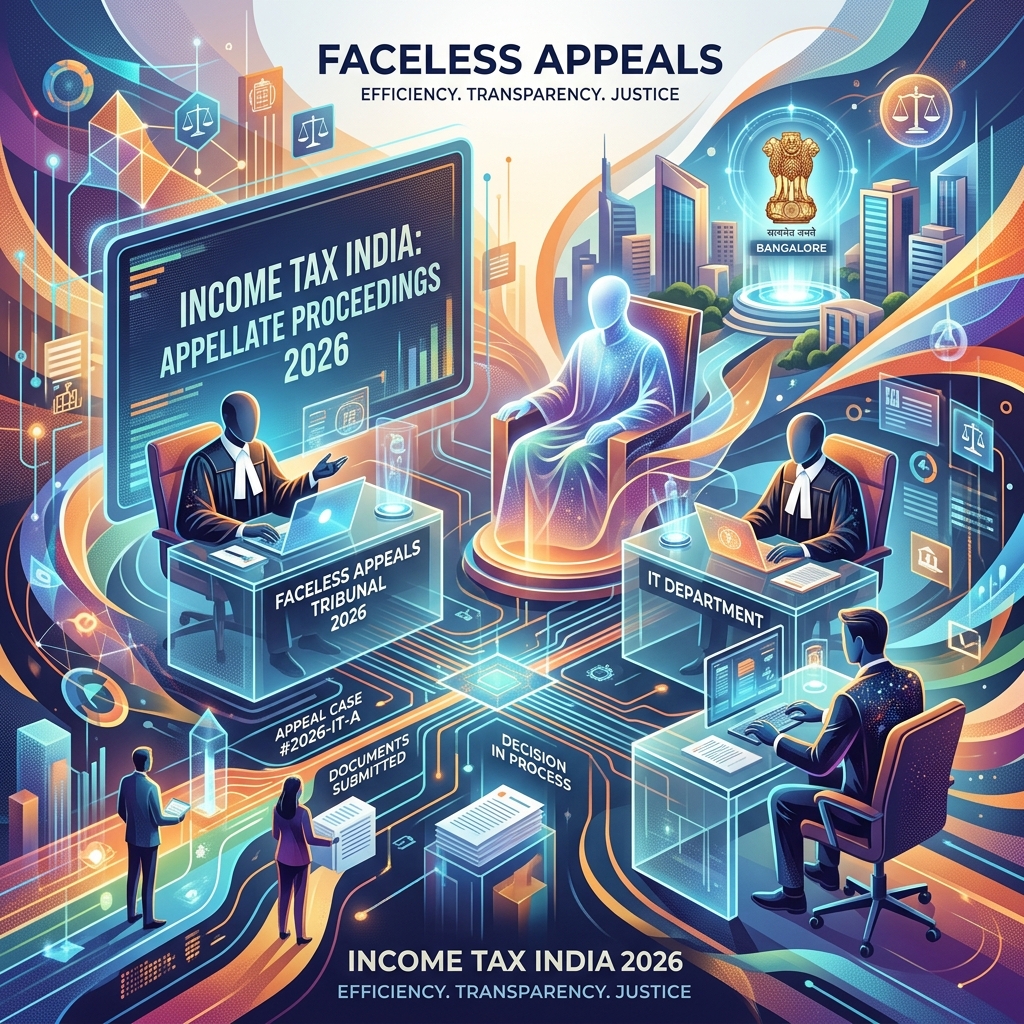
To eliminate corruption, ensure objectivity, and streamline the appellate process, the Central Board of Direct Taxes (CBDT) introduced a revolutionary reform in the direct tax administration of India: the Faceless Appeals Scheme. Governed by Section 250 of the Income Tax Act, 1961, this scheme completely digitizes the appellate process before the Commissioner of Income Tax (Appeals) [CIT(A)]. Taxpayers navigating faceless appeals in income tax india 2026 must understand that the days of physical visits, personal handshakes, and manual file submissions at the income tax office are gone.
Under this scheme, all communication between the taxpayer and the appellate authority is routed electronically through a centralized portal. The identity of the Commissioner deciding the appeal is kept completely anonymous, and the cases are allocated dynamically utilizing artificial intelligence-enabled algorithms. This ensures that the adjudication is based strictly on the written submissions and documentary evidence uploaded on the e-filing portal, completely removing personal bias and geographic limitations.
The Role of the National Faceless Appeal Centre (NFAC)
The operational backbone of the faceless appellate ecosystem is the National Faceless Appeal Centre (NFAC), located in Delhi. The NFAC acts as the single point of contact between the taxpayer and the various Appeal Units scattered across the country.
When a taxpayer files an appeal, it is received by the NFAC. The NFAC then assigns the case to a specific Appeal Unit in a random city. The Appeal Unit reviews the submission, and if additional information is required, they request the NFAC to issue a notice to the taxpayer. The taxpayer uploads their response, which is received by the NFAC and forwarded to the Appeal Unit. This centralized routing ensures that the Appeal Unit has zero direct interaction or knowledge of the taxpayer’s geographical location or identity, safeguarding the integrity of the faceless appeals in income tax india 2026 framework.
Step-by-Step Guide to Filing Form 35
To initiate a faceless appeal, the taxpayer must file Form 35 electronically on the Income Tax e-filing portal within 30 days from the date of service of the demand notice or assessment order. The process requires precise drafting and structured documentation.
| Appeal Step | Critical Deliverable | Common Compliance Pitfall |
|---|---|---|
| Form 35 Submission | Filing within 30 Days of demand notice. | Missing the deadline, requiring a separate Condonation of Delay request. |
| Statement of Facts | A chronological, concise summary of the case. | Being overly emotional or including legal arguments instead of factual history. |
| Grounds of Appeal | Numbered, distinct legal challenges to the additions. | Combining multiple grievances into a single ground or lacking specificity. |
| Appeal Fees Payment | Fee receipt under challan ITNS 280. | Failing to pay the fee prior to filing, making the appeal invalid (defective). |
Additional Evidence & Rule 46A Requirements
In a faceless appeal, you cannot simply upload new documents that were not presented to the assessing officer (AO) during the assessment stage. Under Rule 46A of the Income Tax Rules, 1962, the admission of additional evidence at the appellate stage is strictly restricted.
To admit new evidence, the taxpayer must prove that the AO refused to admit evidence which ought to have been admitted, or that the taxpayer was prevented by sufficient cause from producing the evidence. You must file a separate application under Rule 46A explaining these circumstances. The NFAC will refer the new evidence to the AO for a “remand report.” If the AO’s remand report is negative, you must file a counter-rebuttal. Failing to satisfy the Rule 46A conditions (much like compliance gaps in Alternative Investment Funds (AIFs)) is a major reason why many faceless appeals in income tax india 2026 are rejected on technical grounds.
Video Conferencing: Your Right to be Heard
While the faceless scheme is primarily paperless, there are complex cases where written submissions are insufficient to explain technical points. To ensure fairness, the scheme provides an option for a personal hearing through video conferencing.
Initially, video conferencing was at the sole discretion of the Chief Commissioner. However, following amendments and judicial intervention, the taxpayer now has a **legal right** to request a video hearing. The taxpayer can make this request via their e-filing portal. The NFAC will schedule a secure video link. This allows the taxpayer’s authorized representative (a chartered accountant or tax advocate) to present oral arguments and clarify doubts in real-time, restoring the human element of advocacy within the faceless appeals in income tax india 2026 digital space.
Violations of Natural Justice & Writ Petitions
The speed and automated nature of the faceless scheme have occasionally led to systemic errors, with Appeal Units passing orders without providing show-cause notices or ignoring requests for video hearings. Such actions constitute a clear violation of the Principle of Natural Justice (Audi Alteram Partem — hear the other side).
In such scenarios, taxpayers are not helpless. High Courts across India have routinely entertained writ petitions under Article 226 of the Constitution, setting aside faceless appeal orders that were passed without giving the taxpayer a fair opportunity to respond. While writ jurisdiction is an extraordinary remedy, it remains a vital safeguard for taxpayers facing arbitrary additions under the faceless appeals in income tax india 2026 guidelines.
The New JCIT (Appeals) Scheme for Small Taxpayers
To reduce the massive backlog of cases before the CIT(A), the government introduced the Joint Commissioner of Income Tax (Appeals) [JCIT(A)] scheme. This scheme functions as an additional appellate layer, specifically designed to handle small-to-medium tax disputes.
The JCIT(A) operates under the same faceless protocols as the CIT(A) but handles cases where the tax demand or additions are below specified limits. This bifurcation allows the NFAC to allocate smaller cases to JCIT units, ensuring faster disposal timelines and letting CIT(A) units focus on complex corporate tax, transfer pricing, and international taxation disputes under the faceless appeals in income tax india 2026 ecosystem.
Strategic Drafting of Statement of Facts & Grounds of Appeal
The success of an appeal under the faceless regime is determined almost entirely by the quality of the written submissions. Since there is no physical interaction to explain nuances, the Statement of Facts must be drafted with absolute clarity. It should present a chronological narrative of the assessment proceedings, highlighting the documents submitted to the Assessing Officer (AO) and how the AO failed to appreciate them. A common error is to draft an emotional narrative; instead, the focus must remain strictly objective, referencing specific page numbers of the paper book to allow the appellate unit to verify the facts instantly. When managing faceless appeals in income tax india 2026, ensuring that the facts are presented cleanly is the foundation of a successful defense.
Similarly, the Grounds of Appeal must be drafted strategically. Each addition made by the AO must be challenged through separate, distinct grounds. Taxpayers should include both substantive grounds (challenging the merits of the addition) and technical grounds (challenging the validity of the notice or the assessment order under Section 143(3) or Section 148). For instance, if an assessment was completed without serving a mandatory notice under Section 143(2) within the prescribed time limit, this jurisdictional defect must be raised as a primary ground of appeal. If the technical ground is accepted, the entire assessment order can be quashed, rendering the substantive additions void without even arguing the merits. Additionally, always include a general ground reserving the right to add, alter, or amend the grounds during the course of the proceedings, providing necessary procedural flexibility under the faceless appeals in income tax india 2026 framework.
Handling SCNs and Preparing Rebuttals
During the course of the appeal, the National Faceless Appeal Centre (NFAC) may issue a Show-Cause Notice (SCN) proposing to enhance the assessment or modify the tax treatment. Enhancements are a major risk in direct tax appeals, as the CIT(A) has the power to identify new issues that were missed by the AO and increase the tax liability. When an SCN is received, the taxpayer’s response must be exhaustive, addressing every query with detailed legal arguments and supporting documents. The rebuttal must not merely restate the facts but must dissect the NFAC’s reasoning, utilizing relevant High Court and Supreme Court rulings to show why the proposed enhancement is legally unsustainable.
Furthermore, the response timeline for an SCN is often extremely tight, typically seven to ten days. If the case requires retrieving historical records or coordinating with third parties, the tax director must immediately file a request for extension on the e-filing portal. The request must show ‘sufficient cause’ for the extension, such as the complexity of the data required or medical emergencies. Failing to respond to an SCN within the stipulated time can result in the NFAC passing the final order confirming the enhancement, leaving the taxpayer with no recourse but to file a costly appeal before the Income Tax Appellate Tribunal (ITAT) under the faceless appeals in income tax india 2026 guidelines.
Digital Records Management for Appellate Audits
The transition to a digital appellate system requires corporations to maintain a structured, digital records management system. During a faceless appeal, the NFAC may demand documents that were submitted years ago during the assessment. If the company cannot retrieve these files quickly, or if the files are uploaded as poorly scanned, illegible PDFs, the appellate unit may reject the evidence. Tax departments must implement an electronic archiving system where every document submitted to the AO is indexed, bookmarked, and stored in high-resolution PDF format. Bookmarking is especially critical; a paper book containing hundreds of pages is far more likely to be reviewed thoroughly by the appellate officer if it has a clickable index allowing them to navigate directly to the relevant lease deeds, bank statements, or CA certificates.
Additionally, the size limit for individual file uploads on the income tax portal is restricted (typically 5MB per file). If the taxpayer needs to submit a large volume of ledger accounts or invoices, they must split the files logically and compress them without losing legibility. Each file name must be descriptive (e.g., ‘Annexure_A_Cost_Inflation_Index_Computation.pdf’) to help the NFAC officer understand the contents of the upload. Maintaining this digital hygiene is a critical component of successful advocacy in faceless appeals in income tax india 2026, ensuring that your evidence is not only submitted but actually read and appreciated by the anonymous appeal unit.
The Role of Judicial Precedents in NFAC Adjudication
In a faceless appeal, where personal advocacy is limited, the citation of relevant judicial precedents is the most powerful tool to sway the anonymous Appeal Unit. The NFAC is bound by the decisions of the Supreme Court of India and the jurisdictional High Court of the taxpayer. When drafting the legal submissions, tax professionals must categorize the case laws logically, starting with direct, binding rulings on the exact issue, followed by persuasive rulings from other High Courts or the Special Benches of the ITAT. Simply listing dozens of case laws is counterproductive; the submission must explain the exact factual matrix of the cited case and demonstrate how it aligns perfectly with the taxpayer’s case.
For instance, if the dispute involves the disallowance of ESOP expenses as capital in nature, the taxpayer should cite the landmark rulings of the Bangalore Bench of the ITAT or the relevant High Court confirming that ESOP discount is a commercial expense deductible under Section 37(1). Linking your arguments to established judicial jurisprudence forces the NFAC to either accept your position or provide a detailed, legally sound justification for distinguishing your case. This builds a strong record for any future appeals before the ITAT or higher courts, ensuring that your legal rights are fully protected under the faceless appeals in income tax india 2026 framework.
The Role of Joint Commissioner (Appeals) in Minor Tax Disputes
The introduction of the Joint Commissioner (Appeals) [JCIT(A)] tier represents a significant structural shift designed to expedite the disposal of low-value tax disputes. Under the traditional CIT(A) framework, the massive volume of pending cases led to processing delays stretching from three to five years, causing severe financial strain for small businesses and individual taxpayers. By delegating appeals involving smaller quantum additions (typically below designated thresholds set by the CBDT) to JCIT(A) units, the tax department has created a fast-track corridor. These JCIT(A) units operate under the same strict digital and anonymity protocols as the NFAC, ensuring that small taxpayers receive a fair, unbiased, and swift adjudication of their grievances.
For corporate tax directors, this JCIT(A) delegation is a welcome development as it frees up the senior CIT(A) units to focus on complex, high-value corporate tax assessments, international tax matters, and transfer pricing disputes. However, the JCIT(A) units are strictly bound by the same procedural rules under Section 250, including the restrictions on additional evidence under Rule 46A. Taxpayers must treat JCIT(A) proceedings with the same level of professional diligence as a CIT(A) appeal, ensuring that written submissions are thorough, legal citations are accurate, and digital evidence is uploaded cleanly to secure a favorable outcome under the faceless appeals in income tax india 2026 guidelines.
Recent Judicial Guidelines on NFAC Jurisdiction Limits
As the faceless appellate mechanism has matured, the courts have increasingly been called upon to define the boundary limits of the NFAC’s jurisdiction. A key area of dispute is whether the NFAC has the power to ignore jurisdictional boundaries when reviewing assessments that involve complex factual issues specific to a particular geographical region. In several landmark rulings, High Courts have held that while the allocation of cases to Appeal Units is random and anonymous, the NFAC cannot override the binding precedents of the High Court having jurisdiction over the taxpayer’s physical place of business. If an Appeal Unit located in Mumbai decides a case for a taxpayer based in Kolkata, it must strictly apply the rulings of the Calcutta High Court, even if the Bombay High Court has a conflicting view on the matter.
This judicial clarification is of immense strategic value to tax professionals. When drafting grounds of appeal, you must explicitly highlight the binding jurisdictional High Court rulings that support your position. If the NFAC Appeal Unit applies a conflicting ruling from another state High Court, the resulting order can be challenged as a jurisdictional error and set aside by the court. Ensuring that the NFAC adheres to local High Court precedents is a vital aspect of appellate advocacy, providing a robust layer of legal protection for taxpayers contesting high-value direct tax assessments within the faceless appeals in income tax india 2026 system.
“Faceless appeals are not merely a change in medium; they are a fundamental shift in how tax disputes are fought. Written advocacy, digital records, and strategic legal drafting are the new parameters of success.”
- ✓Verify that Form 35 is filed within 30 days of the service of the Assessment Order and Demand Notice.
- ✓Confirm payment of the mandatory appeal fee based on the total income assessed by the AO.
- ✓Draft a chronological Statement of Facts, avoiding legal arguments or emotional assertions.
- ✓Formulate clear, separate, and numbered Grounds of Appeal for every addition or disallowance.
- ✓Prepare a separate application under Rule 46A if any additional evidence needs to be submitted.
- ✓Set up daily email and portal alerts to monitor the e-filing account for notices from the NFAC.
- ✓Retain high-resolution, bookmarked PDF copies of the complete paper book submitted to the AO.
Pre-Filing Compliance Checklist for Taxpayers
To ensure that your appeal is not rejected on technical grounds before it is even assigned to an Appeal Unit, tax directors must execute a strict pre-filing compliance review. A defective appeal can result in a loss of stay on tax demands, exposing the company to immediate recovery actions by the AO.
For Corporate Tax Teams: Ensure that the appeal fee challan is correctly matched with the assessed income. For assessed income below ₹1 Lakh, the fee is ₹250; for income between ₹1 Lakh and ₹2 Lakhs, it is ₹500; and for assessed income exceeding ₹2 Lakhs, the fee is ₹1,000. Under faceless appeals in income tax india 2026 guidelines, any mismatch in fee payment will instantly trigger a “defective appeal” status on the portal.
For Authorized Representatives: Ensure that your Power of Attorney (Form M-1) or Letter of Authority is signed by the principal officer of the company and uploaded alongside Form 35. If the representative’s authorization is missing or invalid, the NFAC will refuse to schedule video hearings or accept replies, resulting in severe compliance gaps.
Frequently Asked Questions on faceless appeals in income tax india 2026
What is the time limit to file a faceless appeal?
Is video conferencing mandatory in faceless appeals?
Can I submit new evidence during a faceless appeal?
What happens if I miss a notice on the e-filing portal?
What is the difference between CIT(A) and JCIT(A)?
Can a faceless appeal order be challenged?
Is there an appeal fee for filing Form 35?
What is a remand report in a faceless appeal?
- Grounds of Appeal & Form 35 Drafting
- NFAC Written Submissions & Rebuttals
- Video Conference Advocacy & Briefing
- ITAT Appeals & High Court Writ Petitions